
Dementia hallucinations, seeing, hearing, or sensing something that isn't there, are common, especially in later stages or with Lewy body dementia. Delusions, firmly held false beliefs, are different but often confused with them. Most episodes call for the same approach: stay calm, don't argue, and gently reassure. Sudden onset, distress, or a new illness are reasons to call the doctor.
It's the middle of a Tuesday afternoon, and your father’s looking past your shoulder, talking to someone who isn't there. He seems calm, even pleased. Then, you glance behind you and realize there's no one there. Your stomach drops. Do you correct him? Play along? Call someone?
Moments like this catch families off guard, no matter how much they've read beforehand. If this just happened, know that dementia hallucinations are common, and there's a clear, calm way to handle them.
Our Caring Hands Adult Medical Daycare nursing team sees these moments regularly, and we want to help you understand what's happening and what helps.
The two get lumped together, but they're not the same thing.
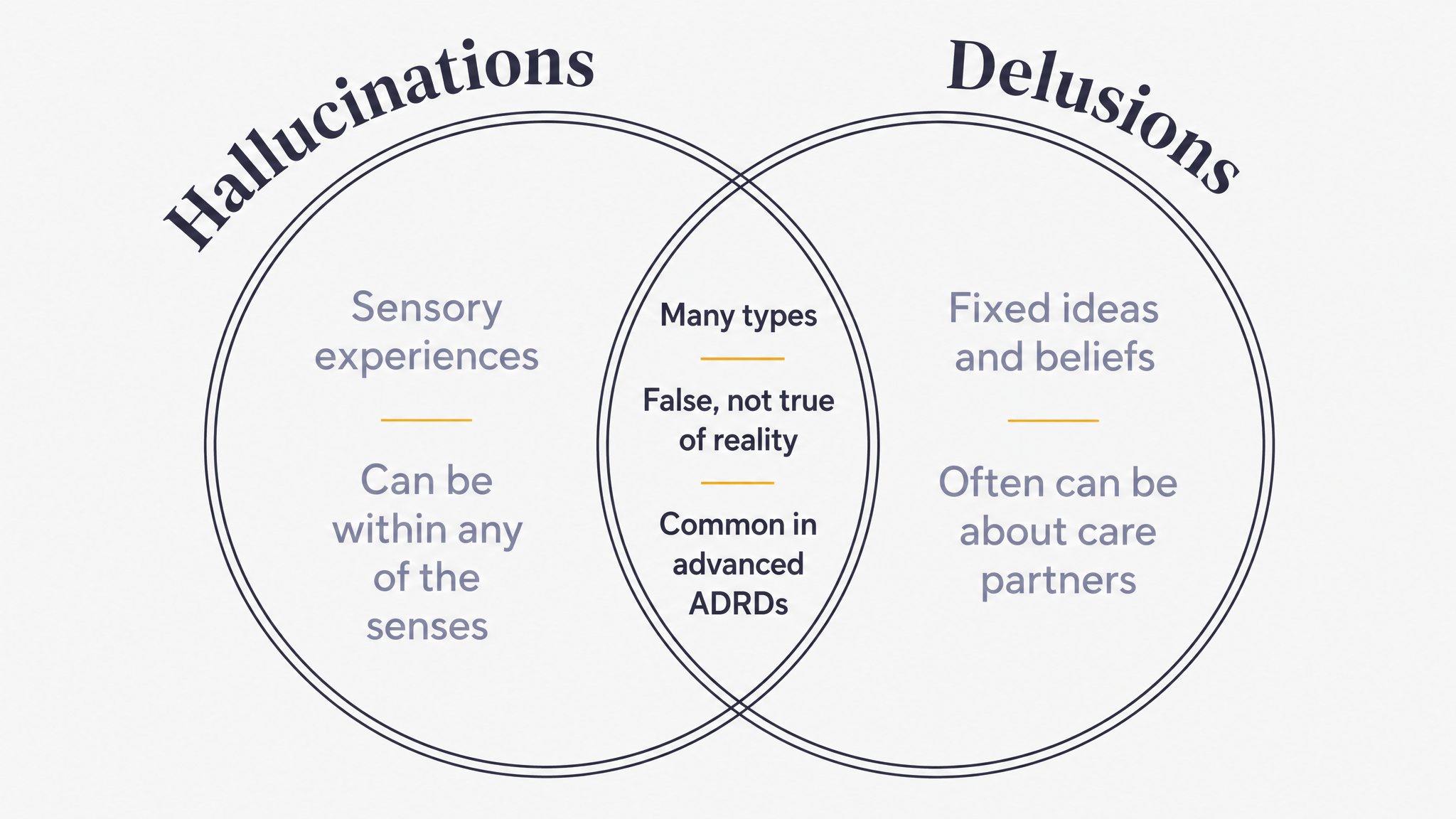
Source: Penn Memory Center
Both are common as dementia progresses. Penn Memory Center's research on dementia hallucinations found that up to half of people in the later stages of Alzheimer's disease and related dementias (ADRDs) experience hallucinations at some point. Delusions are common too, and the two sometimes show up together in the same person.
Dementia changes how the brain processes and interprets what the senses take in. That misfiring is what produces a hallucination or delusion. It’s neither a psychiatric break nor something your loved one can control or reason their way out of.
Dementia hallucinations or delusions show up across dementia types, including vascular dementia, one of the most common causes of dementia after 65 and often overlapping with Alzheimer's.
The pattern shifts by type of dementia.
With Lewy body dementia, visual hallucinations tend to show up early, sometimes before a diagnosis. When it happenes this early in the disease, the person may still sense on some level that what they're seeing isn't real.
With vascular dementia, it's reversed. According to Alzheimer's Society's research on vascular dementia symptoms, delusions happen occasionally, most commonly a belief that someone has taken something from them, or that a loved one who has passed is still alive and due home. Hallucinations happen even less often and tend to appear later, often alongside other late-stage symptoms like agitation or apathy.
That distinction matters. If your loved one has vascular dementia and starts having vivid visual hallucinations early on, speak to their doctor as soon as you can.
Hallucinations and delusions rarely come out of nowhere. A few common triggers show up again and again.
Knowing your loved one's specific triggers gives you something to work with instead of just reacting after the fact.
The instinct to gently correct someone, "Dad, there's no one there," rarely helps and often makes things worse. Arguing about what's real doesn't change what your loved one is experiencing. It just adds confusion and distress.
Don't dismiss what they've described, laugh it off, or leave them alone with it.
It helps to have one simple sequence to fall back on in the moment. Dementia specialists at Penn Memory Center recommend a three-step approach.
None of this requires you to lie or pretend you see what they see. It just means meeting them where they are instead of pulling them into an argument they can't win and don't need to be having.
Most hallucinations and delusions in dementia don't require an emergency call, but a few signs mean it's time to loop in the doctor rather than wait it out.
Mention any illnesses or medications your loved one is currently taking when you call. The NIA’s guidance on coping with hallucinations points out that sometimes an infection or a drug interaction is the real cause, and treating that clears up the hallucinations without anything else needing to change.
Knowing you shouldn't argue is one thing. Staying calm while your father talks to someone who isn't there is another. That gap between what you know and what you feel in the moment is normal. It doesn't mean you're doing this wrong.
Watching someone you love respond to something that isn't there is disorienting, even when you expected it.
Fear, sadness, a jolt of adrenaline, these are ordinary reactions, not signs of failure. Freezing for a second before knowing what to say isn't a mistake either. It takes practice, and you genuinely have no control over what's happening in your loved one's brain.
Right after an episode, once your loved one is calm and safe, give yourself a moment too. A few slow breaths, a text to someone who gets it. Skip the urge to replay what you did wrong. If dread starts building before every shift, that's worth mentioning to a doctor or counselor.
Respite care for caregivers is imparavtive, especially when your loved one has a ADRD.
We won't claim a structured day prevents hallucinations or delusions in people with dementia. But a predictable routine, good lighting, familiar faces, and fewer overstimulating surprises can ease some everyday triggers.
Trained eyes matter too. Our nursing staff and social and therapeutic activities team notice behavior changes during the day and pass them along to families and physicians, often catching a pattern before it becomes a crisis at home.
You shouldn't have to be the only person watching for these changes. At Caring Hands AMDC, our RNs and CNAs are trained to notice shifts in behavior, mood, and perception, and to loop in your loved one's doctor when something looks off. That's one less thing on your plate.
This is one of the most common delusions in dementia, and it's rarely about you specifically. It's usually memory loss. They misplaced something and can't recall doing it, accompanied by a general sense that something feels wrong.
Try not to take it personally, even though that's genuinely hard. Redirecting gently, "let's look for it together," tends to land better than arguing.
Neither, exactly. You don't need to pretend you see what they see, or correct them either. Acknowledge their feelings, then gently reassure them they're safe. That middle ground works better than either extreme.
Yes. Hallucinations tend to appear earlier and more often with Lewy body dementia than with other types. With vascular dementia, delusions are more common than hallucinations, and both tend to show up later as the condition progresses.
Completely normal. Knowing the right response and feeling calm in the moment are two different things, and most caregivers need practice before the second one catches up to the first.
Almost certainly not. There's rarely one perfect line that changes everything. Staying present and keeping your voice steady matters far more than finding exact words. You'll get more comfortable with practice.
Families come to us after a hard stretch of managing these moments alone. What we offer is another set of trained eyes on your loved one every day, and a team that knows the difference between a passing episode and something worth calling the doctor about.
Being there matters more than being right.
Disclaimer: At Caring Hands Adult Medical Daycare, we love sharing resources, tips, and more to help our community thrive. However, please keep in mind that the information on our blog is for educational and inspirational purposes only. While we are experts in care, the content here is not a substitute for professional medical advice, diagnosis, or treatment.
We always recommend speaking with your primary physician or a qualified healthcare provider regarding any specific medical concerns or changes to your loved one’s care plan.