
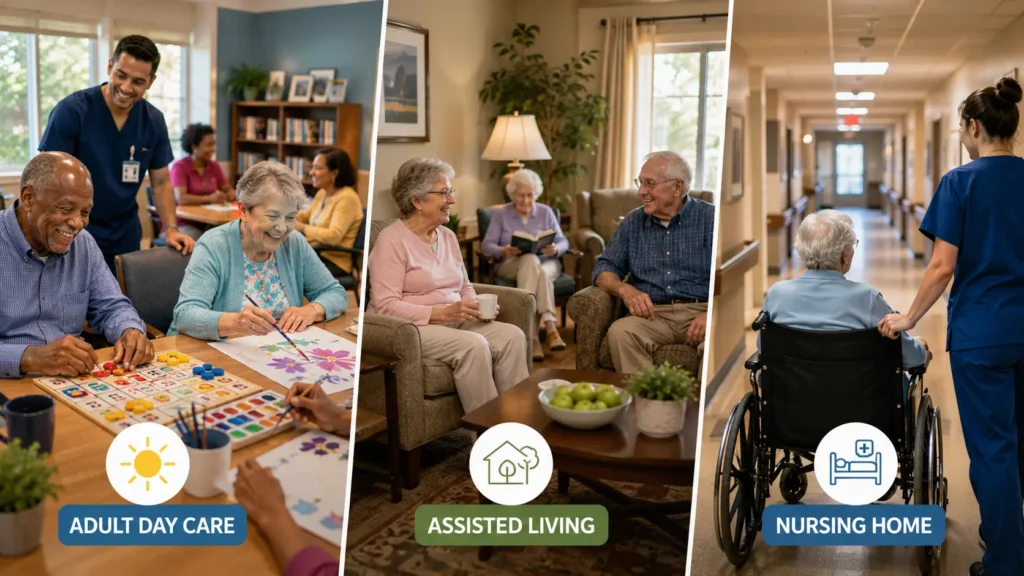
Many families begin comparing adult daycare, nursing homes, and assisted living options when caregiving at home becomes overwhelming. Adult daycare provides professional medical support and social engagement while participants live at home. In contrast, assisted living and nursing homes involve moving into a residential facility. The right choice depends on your loved one’s medical needs, safety concerns, and your family's financial and emotional goals.
Caring for an adult loved one is a journey that often starts with small gestures.
You may begin by helping with errands, but responsibilities slowly grow. Medications become more complex. Safety concerns rise. Eventually, many caregivers ask whether they can safely continue managing everything at home.
When this happens, families often start looking into adult daycare, assisted living, and nursing homes. However, these options serve very different needs. Understanding these differences helps you find the right support for your family at the right time. It prevents you from making a bigger transition before it’s necessary.
The most important distinction between adult daycare and nursing home care is where your loved one lives.
A nursing home replaces the home environment. It offers 24-hour residential care for people who can't live on their own anymore because of their medical care or supervision needs.
Adult daycare supports the home environment. It’s designed for adults who safely live at home but benefit from structure, health monitoring, and social engagement during the day.
In other words, one option replaces the home environment; the other supports it.
Cost is another important factor to consider. Although costs vary, adult daycare is usually cheaper than residential care because the participants go home every night.
A good adult daycare program helps participants stay active, in touch, and cared for all day. Members come in the morning and spend the day in a structured setting with meals, activities, social events, and support services.
At Caring Hands Adult Medical Daycare, participants may spend time enjoying therapeutic programs, connecting with friends, participating in creative activities, sharing meals, or receiving support from our nursing team and personal care staff. Some spend time exercising. Others enjoy games, discussions, music, movies, arts and crafts, or relaxing in our library by the fireplace.
Our goal is helping participants remain active and stimulated while continuing to enjoy life at home with their families.
Families often compare these support systems because both offer social interaction. However, senior centers are for independent adults seeking recreation.
Adult daycare provides additional supervision, medication support, personal care, and medical monitoring. The right choice depends on whether your loved one needs recreation or professional care.
The comparison between adult daycare and assisted living often hinges on one question: Does your loved one need support during the day, or do they need a different place to live?
Assisted living communities provide housing along with support for daily tasks such as meals, housekeeping, medication reminders, and personal care. For many older adults, assisted living offers a welcome balance between independence and support.
However, moving into assisted living means leaving home and becoming part of a residential community.
Adult day care takes a different approach. Instead of changing where someone lives, it strengthens the support they receive while remaining in familiar surroundings.
For many senior adults, that distinction matters. Familiar routines, favorite belongings, family dinners, and sleeping in their own bed can all contribute to comfort and quality of life.
Nursing homes provide the highest level of continuous medical care outside a hospital. They are appropriate for people who require 24-hour nursing intervention or have safety concerns that can’t be managed at home or in assisted living arrangements.
Selecting a nursing home is often the safest and most compassionate decision for families managing complex medical situations.
Asking for support doesn't mean you've failed. It means you love someone whose needs have grown, and you're wise enough to build the care team they deserve.
Determining whether your loved one needs adult daycare, assisted living, or nursing home care depends on your specific situation. While every family's situation is different, these examples can help clarify which option may be worth exploring.
If your loved one is generally managing well but needs supervision, social engagement, medication support, or a structured daily routine, adult daycare may provide the right balance of independence and support.
If your loved one needs a balance between independence, support, and supervision, assisted living can also be a solution. However, looking into the depth of care needed vs. provided in the community.
Many caregivers reach a point where they’re physically and emotionally exhausted.
In situations like these, adult daycare can provide reliable daytime support while families continue to care for their loved one at home.
You might also consider respite care. This service gives caregivers a short-term break. A support caregiver generally either comes to your home, or your loved one is booked into an overnight center for a while. However, adult daycare is a more long-term solution.
If your loved one requires 24-hour skilled care or constant nursing intervention, a nursing home may be the safest and most appropriate option.
Caregivers often expect their loved one to benefit the most from a program, but they’re surprised by their own relief. Knowing your loved one is safe and engaged lets you focus on work, family, or catching your breath.
Familial caregiving is a humongous and continuous undertaking. Few people fully understand the responsibility you commit to or the complete exhaustion you can feel. Needing support or a break isn’t about your skills or love but about sustainability.
Adult daycare doesn't eliminate your responsibilities; it helps distribute them. For many caregivers, that support helps transform caregiving from something that feels overwhelming into feeling manageable again.
If you’re trying to figure out if adult medical daycare is the right next step, the best way to know is to experience it in person.
We have two facilities in the Baltimore area. Just contact us to set up a meeting. You can meet our team and see how we help participants stay active and connected while living at home.
Whether you have questions about services, costs, or scheduling, we’re here to help you make an informed decision.
Adult daycare is a community-based program where participants receive medical and social support during the day before returning home. A nursing home is a residential facility providing 24-hour skilled nursing care.
Adult daycare typically costs less per day than residential options like nursing homes or assisted living. During a tour, we can discuss your specific situation and help you understand the support options available.
For many families, yes. Professional health monitoring, social engagement, and caregiver respite can make living at home sustainable for a longer period.
Not exactly. Adult daycare can provide respite for caregivers, but it also offers structured activities, health support, social engagement, and routine on an ongoing basis. Respite care is short, limited support for unpaid caregivers.
Factors such as medical complexity, safety concerns, mobility limitations, and supervision needs all play a role. Discussing these concerns with healthcare providers can help families evaluate the most appropriate level of care.
Every family's situation is unique, and there is no single answer that fits everyone. The best way to know if we’re the best solution for you is to make an appointment with us.
Disclaimer: At Caring Hands Adult Medical Daycare, we love sharing resources, tips, and more to help our community thrive. However, please keep in mind that the information on our blog is for educational and inspirational purposes only. While we are experts in care, the content here is not a substitute for professional medical advice, diagnosis, or treatment.
We always recommend speaking with your primary physician or a qualified healthcare provider regarding any specific medical concerns or changes to your loved one’s care plan.