A Dementia Stages Chart to Help You Know What Comes Next

The Dementia Stages Chart: What Families Need to Know

Dementia moves through three broad stages, early, middle, and late, which map onto a more detailed seven-stage scale doctors use. Memory and daily tasks slip first, the middle stage brings the biggest communication and safety changes and tends to last longest, and full-time care becomes necessary by the late stage. A dementia stages chart shows when extra support, including adult medical daycare, can help most. 


The doctor says the word "dementia," hands you a pamphlet, and sends you home. Now what?


Most families leave that appointment with more questions than answers. 


A dementia stages chart can't predict your family's timeline; nobody can. However, it can show you what usually happens and roughly in what order, so you have a better idea of what to expect.


At Caring Hands Adult Medical Daycare, we speak with families in this position on a regular basis. Dementia is one of the most common reasons people come to a program like ours. 


The Two Ways Doctors Talk About Dementia Stages

You've probably heard the stages of dementia described as "early, middle, and late." Or maybe you’ve heard a doctor mention a number, like stage 4 or stage 6, and wondered what that meant.


Both are describing the same progression. The three broader stages are the version most families use in everyday life. It’s simple and easy to discuss with relatives who aren't familiar with the medical details. 


The seven-stage dementia scale, sometimes called the Global Deterioration Scale or the Reisberg scale, is what many doctors use for more precise tracking. Neither one is more correct. 


The Dementia Stages Chart

Here's how the seven stages of dementia line up against the three broader ones and roughly what tends to change at each point.


GDS Stage What It Typically Looks Like Early, Middle, or Late Support Needs
1: No Cognitive Decline No noticeable memory or thinking changes Not dementia yet  None needed
2: Very Mild Decline Occasional forgetfulness, often mistaken for normal aging Not dementia yet  None needed
3: Mild Cognitive Decline Noticeable memory lapses, trouble finding words, others start to notice Borderline early Usually still independent, a good time for planning conversations
4: Moderate Decline Real trouble with complex tasks like finances or planning; diagnosis often happens here Early Can often stay home with some support; day programs start becoming genuinely useful
5: Moderately Severe Decline May forget an address or personal history, needs help choosing clothing Middle Widely considered the point where daily life can no longer be managed alone
6: Severe Decline Needs help dressing, bathing, and using the bathroom; personality changes, may not recognize familiar faces Middle Needs substantial daily assistance; many families combine daycare with added home support
7: Very Severe Decline Loss of speech and most physical ability Late Needs continuous, hands-on care beyond what a daytime program alone covers


Stage 5 is the one worth circling. It's generally considered the point where a person can no longer get through a day safely without help from someone else.


What Do Stages 1 and 2 Really Mean?

These are the two stages that confuse people most, because there's genuinely little to notice yet.


Stage 1 is what doctors call "no cognitive decline." A person here has no memory complaints, and nothing shows up in a clinical interview. In practice, this stage describes anyone without dementia and with healthy cognition at any age. It sits on the scale mostly as the starting reference point, not something a doctor would ever tell a specific person they've reached.


Stage 2 is "very mild cognitive decline," and it's the one most people mistake for just getting older. Someone might notice they're forgetting where they left their keys or blanking on a familiar name more than usual. The important part is that these are the person's own observations. 


Nothing shows up on a formal cognitive test yet, and coworkers or family don't notice anything different. Most people who experience these symptoms never go on to a dementia diagnosis at all; it can be ordinary aging.


So, how would you know which stage someone is in? Staging comes from a structured clinical interview, a doctor weighing what they observe against what the person reports, sometimes alongside formal cognitive testing. 


For stages 1 through 3, formal staging usually doesn't happen at all. There's rarely enough happening to warrant it, and a dementia diagnosis typically isn't made until stage 4, once the pattern is clear rather than an isolated complaint.


If you're noticing small changes in your loved one and wondering what they mean, that uncertainty is normal. Speak to a medical professional about what you’ve noticed. 


What Changes at Each Stage of Dementia

Early Stage of Dementia

This stage is where a diagnosis usually lands. Someone in the early stage can often still live independently, but you'll notice real gaps. They’ll have trouble reading, writing, or working with numbers. They are confused about time or places and misplace things without being able to retrace steps. 


This is also a good window to work through a room-by-room home safety checklist before a fall or a wandering incident forces the issue.


Middle Stage of Dementia

This stage is usually the longest and is often described by caregivers as the hardest. 


Communication gets harder. Someone may forget their address, get confused about where they are, or struggle to follow a conversation. The middle stage is also where behavior changes tend to show up, like agitation, suspicion, night-time wandering, or the restlessness some caregivers know as sundowning. 


Late Stage of Dementia

We’re keeping this part brief and factual, on purpose. In the late stage, physical decline becomes the bigger concern, followed by mobility, swallowing, and eventually speech. Full-time, hands-on care becomes necessary, and preserving dignity through that care matters just as much as the care itself. 


If you're working through behavior changes at any point along the way, know that support exists at every stage, not just this one.


How Long Does Each Dementia Stage Tend to Last?

There's no universal timeline, and be wary of anyone who gives you a firm number. 


What we can say, based on the Alzheimer's Association's own data, is that a person with Alzheimer's lives, on average, four to eight years after diagnosis. However, some people may live as long as twenty years after diagnosis. The middle stage is typically the longest of the three, sometimes stretching for years.


The type of dementia, overall health, and access to quality support all shift that timeline. Your family's version won't match a dementia stages chart exactly, and that's normal.


Where Adult Medical Daycare Fits In

Adult daycare offers the most value in the early and middle stages. It’s for when someone still lives at home but genuinely can't be alone all day anymore or needs more stimulation and interpersonal interaction than you and your family can provide. 


That's the window where activities built around memory and movement do the most good. During these dementia stages a predictable daily routine, including meals, socialization, physical and mental activities, and supervision, gives both your loved one and you something steadier to stand on.


It's not an either-or decision against staying at home. Most families use adult daycare alongside home life for years before anything else changes, and knowing that your loved one is safe and engaged during the day is as valuable as the routine itself.


About Late-Stage Dementia Care

As dementia moves into the late stage, care needs generally outgrow what a daytime program alone can provide. It usually means bringing in more comprehensive support, whether that's expanded home care or a higher level of residential care. 


Taking Care of Yourself Through Every Stage

Every stage on the dementia chart asks something of your loved one. But they also ask something of you, and that part rarely makes it onto a chart.


Learning that a loved one, even a spouse, has dementia or Alzheimer's disease is a devastating blow. It's normal to grieve someone who's still alive. Grief is a real and recognized part of dementia caregiving, not something that must be reserved for after a death. 


You might be mourning the conversations you used to have or the version of your parent who remembered your birthday without a reminder, even while they sit across from you. 


That grief doesn't mean you've given up on them or that there’s something wrong with you. It highlights the sincere love you have for them, and it means you're paying attention.


Here are a few things that genuinely help caregivers at any stage.

None of this replaces real support. If you're at the point where you need consistent hours back each week, it is not failure. It's the practical next step, and it's what a structured day program is built for.


Reading a chart is one thing. Living it day to day with someone you love is another. Caring Hands AMDC has supported families across Dundalk and Greater Baltimore through the stages of dementia for more than twenty years, and we know the questions that come up long after the pamphlet's been read.


Speak to Us About Dementia Daycare


What Families Ask About Dementia Stages 

Do All Types of Dementia Follow the Same Stages? 

Not exactly. Most staging charts, including the one above, were built around Alzheimer's disease specifically, since it's the most common and most studied form of dementia. Other types, like vascular dementia or Lewy body dementia, can progress differently or unevenly. The stages are still a useful general guide.


Is It Important to Know Which Stage Someone Is In?

It helps more than it might seem, but not because the number matters. Knowing roughly where your loved one is helps you plan practical things while there's still time. Consider things like legal and financial paperwork and conversations about future care preferences. It gives you and their doctor a shared language for what's changing. 


What it shouldn't do is become something to obsess over day to day. The stage is a rough marker for planning, not a verdict, and two people at the same clinical stage can still look very different from each other. 


Can Someone Move Backward Through the Stages, or Skip One? 

Progression isn't always a straight line. An infection, hospital stay, or rough medication reaction can cause a sudden, sharp decline that looks like skipping a stage. Some of that can ease once the underlying cause is treated. True stage-by-stage reversal doesn't happen, but short-term dips and rebounds are common enough that one bad week doesn't mean a permanent jump.


Is There an Official Test to Find Out What Stage Someone Is In? 

Yes. Doctors use a structured tool called the Global Deterioration Scale, the same 7-stage dementia scale referenced above, to assess where someone falls. If you want a clearer answer than a chart can give you, ask your loved one's physician about a formal staging assessment.


What if My Loved One's Symptoms Don't Match the Stage They're "Supposed" to Be In? 

That's common, not concerning. Two people at the same clinical stage can look quite different in their daily actions. Charts describe patterns, not people. Trust what you're observing over what a chart predicts.


Should We Tell Family and Friends Which Stage Our Loved One Is In? 

That's a personal call, and there's no wrong answer. Some families find that naming the stage helps relatives understand what to expect and how to help. Others prefer to describe specific changes rather than a stage number. Do whatever makes those conversations easier for you.


A Program That Grows With Your Family's Needs

Every stage on this chart asks something different of a caregiver. Caring Hands AMDC is built to meet families wherever they land, with on-site nursing, structured activities suited to memory loss, and a team that's seen this progression up close, many times over.


Speak to Our Care Team


Every day looks a little different here, and that's the point.


Disclaimer: At Caring Hands Adult Medical Daycare, we love sharing resources, tips, and more to help our community thrive. However, please keep in mind that the information on our blog is for educational and inspirational purposes only. While we are experts in care, the content here is not a substitute for professional medical advice, diagnosis, or treatment.

We always recommend speaking with your primary physician or a qualified healthcare provider regarding any specific medical concerns or changes to your loved one’s care plan.


Spot the Common Signs of Caregiver Burnout Before It Grows

What Are Common Signs of Caregiver Burnout, and What Helps

A common sign of caregiver burnout is losing interest in things you used to enjoy. It’s when rest stops feeling like rest. It's different from ordinary tiredness and from compassion fatigue and builds gradually rather than arriving all at once. Burnout can be especially hard when caring for a spouse.


You tell yourself you're just tired. But you've been telling yourself that for months.


Caregiving does that. It convinces you that what you're feeling is normal. That everyone feels this way and that you just need a good night’s sleep. Your tiredness will pass eventually. Sometimes it does pass. Yet, sometimes what you're calling "just tired" is caregiver burnout, and it won't fix itself with a decent night's rest.


At Caring Hands Adult Medical Daycare, we speak to care partners every week who are exhausted and didn't even realize how long they'd been feeling that way. This guide explains the common signs of caregiver burnout you might be missing and what genuinely helps.


What Is Caregiver Burnout?

Caregiver burnout is a state of deep physical, emotional, and mental exhaustion that builds from the ongoing weight of caring for someone else. Cleveland Clinic describes it as feeling like you have nothing left to give, like a sense of numbness and disconnection from the life you had before.


It's not the same as a rough week. It's what happens when a rough stretch never quite lets up.


Feeling burnt out when caring for someone is completely normal. You have nothing to feel guilty about. 


Common Signs of Caregiver Burnout You Might Be Missing

Many people who struggle with caregiver burnout say that they have lost interest in the things they used to enjoy. You’re not hating life. It’s just, nothing pulls at you the way it used to. The show you looked forward to. The call with your sister. The garden. It can feel pointless or as if you don’t have the energy to face it. 


It's easy to dismiss this feeling as just being too busy. Don’t do that; pay attention to what else is going on with you. 


Signs of caregiver burnout


Is It Burnout, or Are You Just Tired?

Ordinary tiredness lifts with rest. You sleep. You recover. You're mostly back to yourself. 


Burnout doesn't work that way. You can sleep a full night and still wake up depleted, because the exhaustion isn't only physical anymore. Now the exhaustion has settled into how you feel about your days.


That's the line to watch. If rest stopped helping a while ago, that's not weakness. That's information.


Caregiver Burnout vs. Compassion Fatigue

These two get confused often, and they're related but not identical. Burnout is the deep exhaustion and stress that builds from the demands of caregiving, the tasks, the hours, the responsibility. 


Compassion fatigue happens when you absorb the emotional weight of someone else's suffering. It can cause a lack of empathy or a lack of care for the person you're looking after.


You can experience one without the other or both at once. Both are real, and both deserve attention instead of being pushed down.


Caregiver Burnout Doesn't Arrive All at Once

There's no checklist for the stages of caregiver burnout, like there is for something like dementia, but it rarely arrives suddenly. It tends to start small. You skip your own doctor's appointments. Say "I'm fine" out of habit, not honesty. 


Caregiver burnout grows heavier the longer it goes unaddressed. 


The National Institute on Aging puts it best, “It's not always obvious when a person needs help, which is precisely why catching the early signs matters more than waiting for a breaking point.”


When You're Caring for a Spouse, Not a Parent

Caring for a parent and caring for a spouse aren't the same experience, even when a lot of the daily tasks look similar. Burnout as a spouse caregiver tends to show up differently too. Mayo Clinic specifically names caring for a spouse as a factor that raises the risk of caregiver stress.


A few reasons why:


None of that makes the caregiving less meaningful. It does make caregiving heavier, and it should be recognized as its own kind of hard.


What Helps Caregiver Burnout

Doing a few things consistently can make a real difference.


For some families, a structured day program becomes part of the answer too. It's not stepping away from caregiving; it's getting consistent hours back each week, while your loved one keeps their independence and dignity in a place built around both. If that's a piece you haven't looked into yet, we can show you what a typical day looks like.


Don't Carry It All on Your Own

Caring Hands AMDC has spent more than twenty years alongside families in Dundalk and Greater Baltimore, and we know burnout rarely announces itself. It just quietly becomes normal, slowly depleting you. Real peace of mind starts with someone else sharing the load, even for a few hours a week, and we're here whenever you're ready for that.


Explore a Typical Day


What Caregivers Ask Us About Burnout

Is It Normal to Feel Resentful Toward the Person You're Caring For? 

Yes, and it doesn't make you a bad caregiver nor a bad person. Resentment usually shows up because you're exhausted, not because you love the person any less. What matters is what you do with the feeling; naming it and getting support tends to help. Don’t push it down.


Can Caregiver Burnout Affect My Physical Health, Not Just My Mood? 

Yes, and it's not just correlation. Ongoing stress keeps your body in a heightened state that, over time, can wear down your immune system and make you more prone to getting sick. 


If you've noticed you're catching every cold that goes around, or something like your blood pressure has crept up since you started caregiving, speak to your doctor about it. 


What if There's No One Else to Share the Caregiving With? 

Start smaller than you think you need to. A few hours a week from a friend, a neighbor, or a structured program still counts as real relief, even if it's not a full team of help.


What Should I Do the First Time I Suspect It's Burnout? 

Start with one honest conversation. It can be with your doctor, a therapist, or another caregiver who'd understand. You don't need a diagnosis or a plan before you say it out loud. Naming it early, before you hit a breaking point, is what changes how the next few months go.


Is It Selfish to Look Into Outside Support, Like a Day Program? 

Not at all. Getting consistent breaks tends to make people better caregivers, not worse ones. Looking after your own capacity is part of caring well for your loved one.


Real Support, Whenever You're Ready

We've supported families through every stage of caregiving since 2003, and we know asking for help can feel like a hurdle. It doesn't have to be a big first step. A conversation is enough to start.


Ask Us a Question


Taking care of yourself isn't a break from caregiving. It's part of doing it well.


Disclaimer: At Caring Hands Adult Medical Daycare, we love sharing resources, tips, and more to help our community thrive. However, please keep in mind that the information on our blog is for educational and inspirational purposes only. While we are experts in care, the content here is not a substitute for professional medical advice, diagnosis, or treatment.

We always recommend speaking with your primary physician or a qualified healthcare provider regarding any specific medical concerns or changes to your loved one’s care plan.

Vascular Dementia Stages and Timelines: What to Expect

Vascular Dementia Stages and Timeline: The Real Pattern 

The "7 stages of vascular dementia" chart is borrowed from Alzheimer's research. Vascular dementia actually moves in three stages (early, middle, late), with sudden step-downs after a stroke or TIA, followed by periods of genuine stability. Between events, symptoms hold. Knowing this pattern changes how you plan care.


The "7 Stages" You're Searching For Aren't Vascular Dementia's 

If you've been searching for the 7 stages of vascular dementia, most sites won't tell you that this model wasn't built for vascular dementia. The "7 stages" chart on senior care you find online is the Global Deterioration Scale. It was built for Alzheimer's disease. 


Vascular dementia follows a different pattern. If you're caring for someone who's had a stroke, the leading cause of vascular dementia, understanding that pattern is more useful than memorizing a borrowed chart. 


How Vascular Dementia Really Progresses

Vascular dementia doesn't progress the way Alzheimer's does. Alzheimer's involves a slow, steady decline. Vascular dementia moves in steps. 


There are periods of stability, then sudden drops. Those drops usually follow a stroke or a TIA (transient ischemic attack, sometimes called a mini-stroke). Between events, symptoms can hold steady for months.


Vascular dementia is described in three stages: early, middle, and late. Not seven fixed points.


Early stage

Symptoms are often subtle. They have trouble concentrating, think slower, have difficulty planning, and have some memory lapses. Most people are still living on their own at this point, though certain tasks get harder. This stage can last months or years.


Middle stage

This phase is the longest stage for most people. Confusion increases, language gets harder to follow, and daily tasks like bathing, dressing, or cooking start to need help. Symptoms often worsen in sudden steps, right after a stroke or TIA, not gradually.


Late stage

This stage follows a larger vascular event. It's often the shortest, around a year or two. Memory loss becomes severe, communication and mobility drop sharply, and full-time care becomes necessary.


Where the "7 Stages" Chart Really Comes From

The "7 stages" model is called the Global Deterioration Scale, developed by Dr. Barry Reisberg in 1982. It was designed for Alzheimer's disease. It tracks a memory-first decline, from no impairment through to total dependence.


Vascular dementia doesn't follow that memory-first pattern. Its stepwise, event-driven progression doesn't fit into seven fixed points. Some research has looked at using the scale for vascular dementia too, so it's not entirely wrong. But it wasn't built for this condition. 


A chart suggesting your loved one will move through seven numbered stages of vascular dementia promises more precision than vascular dementia actually has. If you've found a "7 stages of vascular dementia" chart online, what you're looking at is the Alzheimer's scale relabeled. It's not a system built for the disease your loved one has.


What Really Triggers a Step-Down

The biggest declines of vascular dementia follow a specific event, like another stroke, TIA, or a stretch of uncontrolled blood pressure. Between events, someone can look normal. Not just coping, but functioning close to where they were before.


That stability matters for care planning. A "7 stages" chart implies fixed, predictable decline. Planning around that can backfire two ways. 


  1. You might over-prepare for changes that don't come on schedule. 
  2. Or you might miss that a sudden drop after a stroke needs a fast response.


This situation is where daycare can make a huge difference. During a stable period, structured daycare gives someone routine, social contact, and oversight. It doesn't assume decline is around the corner just because a chart says so. And because strokes are the leading cause of vascular dementia, stroke recovery support is already part of what our centers do every day.


Understanding What's Ahead Doesn't Mean Facing It Alone

Whether your loved one is early in a vascular dementia diagnosis or recovering from the stroke that caused it, adult daycare can help. It offers real structure during stable periods, plus the oversight that matters if things change quickly.


Learn About Our Daycare Program


General Questions About Vascular Dementia Stages

Is Vascular Dementia the Same as Alzheimer's?

No. They're different conditions with different causes. Alzheimer's involves a slow, steady decline tied to changes in brain tissue. Vascular dementia results from reduced blood flow to the brain, often from strokes, and moves in a stepwise pattern instead. The two often occur together. When they do, it's called mixed dementia.


Can Vascular Dementia Stay Stable for a Long Time?

Yes. Between vascular events, someone can hold steady for months or even years. Not just avoiding further decline, but functioning close to their baseline. That's when structured routine and engagement, like daycare, help the most.


What's the Vascular Dementia Life Expectancy After Diagnosis?

Every situation is different. Research puts the average life expectancy at around 3 to 5 years after diagnosis, but this varies a lot depending on overall health and whether further strokes occur. That's an average across many people, not a prediction for any one person. Your loved one's doctor, who knows their full picture, is the right person to ask.


Is the "7 Stages" Chart Completely Wrong for Vascular Dementia?

It's not entirely wrong, but it wasn't built for vascular dementia. The scale was designed for Alzheimer's. Some research has looked at using it for vascular dementia too. But it's a borrowed framework, not vascular dementia's own system, and it implies more predictability than this condition tends to show.


A Stable Routine, Whatever Stage You're In

Stable periods are when structure and routine matter most. At Caring Hands AMDC, every day is built around that. Activities and oversight keep your loved one engaged. And you know they're taken care of when something changes.


Ask What a Typical Week Looks Like


Disclaimer: At Caring Hands Adult Medical Daycare, we love sharing resources, tips, and more to help our community thrive. However, please keep in mind that the information on our blog is for educational and inspirational purposes only. While we are experts in care, the content here is not a substitute for professional medical advice, diagnosis, or treatment.

We always recommend speaking with your primary physician or a qualified healthcare provider regarding any specific medical concerns or changes to your loved one’s care plan.
Getting Paid to Care for an Elderly Parent in Maryland

How to Get Paid to Care for an Elderly Parent in Maryland

You can get paid to care for an elderly parent in Maryland through Medicaid (Community First Choice or Community Personal Assistance Services), VA benefits if they served, or a private care agreement. None is simple, and rates change. Confirm with Maryland Access Point before planning around any of it.


The Math That can Fall Through the Cracks

You've started doing the math in your head, probably more than once. The hours you're not billing because you left work early again. The shift you turned down. The retirement contribution you paused. 


Caring for your parent isn't just emotionally exhausting. Financially, it’s real pressure too, and at some point the question becomes concrete, “Is there any way to get paid for at least some of this?”


The answer is yes, sometimes, through a handful of specific programs, but none of them are simple, and none of them work quite the way the ads make it sound. There are financial and support available to Marylad families. However, what we’re discussing here is receiving an allowance for your caregiving. 


Getting Paid Through Maryland Medicaid

Maryland runs two Medicaid programs that can help pay for a caregiver's time, and people often confuse them.


Community First Choice is the broader of the two. There's no age limit, but your parent needs to already have full Medicaid and require an institutional level of care. It covers personal assistance along with services like home-delivered meals and nurse monitoring.


Community Personal Assistance Services has a lower threshold. Your parent needs full Medicaid too, but only needs help with one activity of daily living, not an institutional-level need. It's a narrower program, mainly personal assistance and nurse monitoring.


Both let a Medicaid recipient direct their care (meaning they choose who provides it). Nationally, a large KFF survey of state Medicaid programs found that states generally allow payments to family caregivers under these types of programs. 


However. 


Under federal Medicaid rules, adult children caring for a parent are not classified as "legally responsible relatives." That term mainly covers spouses and parents of minor children. The extra restrictions that apply to paying a spouse don't apply to you.


Neither Maryland program explicitly says "yes, you can be hired as your parent's paid personal caregiver." Caregiver resource organizations consistently report that specific mechanic, and it lines up with the national data. The state just doesn't state it outright. 


So, call Community First Choice at 410-767-1739 or Maryland Access Point at 844-627-5465. Ask specifically whether self-direction under your parent's program allows hiring an adult child.


If Your Parent Is a Veteran

If your mom or dad served, look into the VA's Program of Comprehensive Assistance for Family Caregivers. It pays a monthly stipend to an eligible family caregiver. But the veteran has to meet specific criteria. 


It's a different benefit from VA Aid and Attendance, which increases your parent's pension rather than paying you directly, though that extra income can still go toward care, including daycare. Eligibility rules and stipend amounts get reviewed regularly, so confirm current numbers with the VA rather than what you find online.


Private Care Agreements

If neither Medicaid nor VA routes apply, families sometimes set up a private personal-care agreement. This is a written contract where your parent (or their estate) pays you for specific caregiving duties at a documented rate. 


It's not a government program, so there's no application to submit. But it matters more than people expect. A clear, written agreement can protect everyone if Medicaid eligibility ever gets assessed later. Unpaid family care can sometimes raise questions during that process, while a properly documented agreement generally doesn't. 


Set the agreement up with an elder-law attorney, precisely because it needs to hold up later, not just feel fair now.


How This Connects to Daycare

Getting paid for your caregiving role and getting your parent into daycare aren't competing options. They're often the same conversation.


The Medical Day Care Services Waiver is a separate Medicaid program from Community First Choice and Community Personal Assistance Services. It doesn't pay a caregiver's wages. Instead, it pays for adult daycare in Dundalk, Maryland, for an adult who's 16 or older, needs a nursing-facility level of care, and has a medical order for it. 


If your parent qualifies, this waiver can cover medical daycare for at least four hours a day, up to seven days a week, including meals, activities, and skilled nursing.


There's also a more direct connection to consider. On the same national KFF survey mentioned above, payments for adult day center visits showed up as one way some states structure Medicaid respite care, the short-term relief benefit meant to give family caregivers a break. 


To find out if that specific option applies to your parent's plan in Maryland, ask Maryland Access Point about your options.


One program can pay for the hours you're providing care, and a separate one can cover the hours your parent spends safely at adult daycare. 


Confirm Before You Count On Anything

Every program above changes. Eligibility rules, payment rates, and application processes get updated, and what's true this year may not hold next year. Don't rely on a specific number you saw on a blog for anything you're planning your finances around. 


Call Maryland Access Point at 844-627-5465, or check the state's long-term services and supports pages, before you make a decision based on expected income.


Let’s See What You Need

Paid caregiving program, VA benefits, or none of the above, whatever applies, daycare at Caring Hands Adult Medical Daycare is often the piece that makes the rest of the math work. 

Structured care during the day means you can keep working, keep earning, and keep your own life running.


Find Out How We Can Help


Questions About Getting Paid to Care for an Elderly Parent in Maryland

How Much Can a Family Caregiver Get Paid in Maryland?

It depends on the program, your parent's care needs, and current state rates, which change. We can’t give you a number, not even an estimate, because any figure you see online is likely to be outdated by the time you read it. 


Call Maryland Access Point at 844-627-5465 for current rates for your specific situation.


Does Medicare Pay for a Family Caregiver?

No, and this is a common mix-up. Medicare doesn't pay for long-term care or adult day services, regardless of who provides them. Medicaid is the program that sometimes does, under the specific circumstances.


Can I Get Paid to Care for My Parent If I Live With Them?

Generally, living with your parent doesn't disqualify you from most of the programs above, but it can affect which option fits best, and some programs assess your household differently. You can confirm it when you reach out to them.


What's the Difference Between Community First Choice and the Medical Day Care Services Waiver?

Community First Choice can pay for personal assistance, which may include a family caregiver's time. The Medical Day Care Services Waiver pays for the daycare program itself, not a caregiver's wages. They're separate benefits with separate eligibility rules. Families should look into both.


Do I Need a Lawyer to Set Up a Private Care Agreement?

You're not legally required to, but it's beneficial. An elder-law attorney can make sure the agreement is documented in a way that holds up if Medicaid eligibility is reviewed later, which is when an informal arrangement tends to cause problems.


Caring for Them Shouldn't Cost You Everything

Daycare at Caring Hands Adult Medical Daycare doesn't compete with paid caregiving programs. It works alongside them. While your parent is with us, you can keep working and keep earning. That's the math most families never see laid out.

Talk to Our Team About Your Options


Disclaimer: At Caring Hands Adult Medical Daycare, we love sharing resources, tips, and more to help our community thrive. However, please keep in mind that the information on our blog is for educational and inspirational purposes only. While we are experts in care, the content here is not a substitute for professional medical advice, diagnosis, or treatment.

We always recommend speaking with your primary physician or a qualified healthcare provider regarding any specific medical concerns or changes to your loved one’s care plan.

What to Do When a Dementia Patient Refuses a Care Home

Dementia Patient Refusing to Go Into a Care Home? Here's What Helps

When a parent with dementia refuses to go into a care home, it's rarely stubbornness; it's fear, loss of control, or the disease literally blocking self-awareness. The middle ground most families miss is adult medical daycare, where they sleep in their own bed but spend their days supervised and engaged.

The Conversation That Goes Sideways Every Time

You've had the conversation three times now, and it always goes the same way. 


You bring up "maybe getting some help," and your dad's face closes like a door. "I'm not going into a home." 


You try again, gentler this time, and get the same wall. Meanwhile, you're the one managing his pills, canceling plans to check on him, and lying awake wondering what happens if he falls and you're not there. 


If this sounds like your kitchen table, you're not doing anything wrong. A dementia patient refusing to go into a care home isn't rejecting you. Usually, they're rejecting the loss of control that comes with it. There's real ground between doing nothing and moving your dad into residential care, and understanding the difference between adult daycare and a nursing home is where that ground starts.


Why a Dementia Patient Refuses to Go Into Care

Refusal usually comes from two different things, and it helps to tell them apart.


The emotional reasons are the ones you'd expect from anyone facing a loss of independence. Fear of the unknown. The stigma still attached to "a home," even when nobody says the word out loud. And underneath both, a loss of control that's genuinely hard to sit with. 


Your parent has run their life for decades. Being told what's best for them, even gently, can feel like being erased.


The cognitive reason is different, and it's the one families miss most often. Dementia can affect a person's insight into their condition, a symptom called anosognosia. It's not the same as denial in the way we usually mean it. Denial is psychological. Anosognosia comes from changes in the brain, and it means your parent may genuinely not perceive how much has changed. 


From where they're standing, there's nothing to fix. Arguing the facts rarely works here. That’s because the problem isn't a disagreement about facts; it's that the part of the brain that would recognize the facts is the part that's affected.


Ask the questions you haven't said out loud yet.


How to Talk About It Without Starting a Fight

A few things tend to help more than logic does.


What Are the Legal Boundaries?

As long as your loved one has decision-making capacity (meaning they can understand the situation), weigh the options, and communicate a choice, they're legally allowed to refuse care, even care you think they need.


Capacity isn't the same as agreement. A parent can make a choice you disagree with and still have full legal capacity to make it. What changes things is when the dementia has progressed to the point where they genuinely can't understand the risks anymore.


This situation is where "talk to a lawyer" usually gets said, and nobody follows up, so here's where to start in Maryland. 


None of this is legal advice, and capacity and guardianship law get complicated fast. If you're genuinely at the point of asking whether you can or should make this decision for your parent, that's a conversation for an attorney, not a blog post.


The Middle Ground People Forget

So many caregivers only look at at-home care with full-time support or a care home as if those are the only two options. They're not.


Adult medical daycare is the middle ground. 


Your parent sleeps in their bed every night. They keep their routine and their sense of ownership over their life and stay in a place where they feel safe and comfortable. 


During the day, they're at a center with structured and dementia-specific activities and oversight, nutritional and physical care, medically trained staff, and other people around them, instead of alone in the house while you're at work, worrying.


For a parent who's specifically refusing to go into a care home, this option changes the conversation. You're not asking them to leave home. You're asking them to spend part of their day somewhere safe, stimulating, and honestly, less isolating. 


Attending an adult daycare center is often a much easier yes, or at least a much easier first step, than the conversation about moving out.


A First Step That Doesn't Feel Like Giving In

A day at Caring Hands Adult Medical Daycare isn't a decision about where your parent will live. It's structured activities, oversight, medical support, and company during the hours you can't be there, while they continue to sleep in their own bed every night. For many families, it's the step that makes the bigger conversation easier later.


See What a Day Looks Like


Frequently Asked Questions About a Parent Refusing Care

At What Point Do I Need to Step In and Decide for Them?

There's no single line, but a reasonable marker is when your parent's safety is at real, immediate risk, like wandering, leaving the stove on, or missing critical medication. When they can no longer understand or weigh that risk, or when caring for them exceeds what you can reasonably manage. 


What If I've Tried Talking and Nothing Is Working?

Give it more than one attempt before deciding it's failed. Refusal often softens over several calm conversations, not one. If it genuinely isn't moving after multiple tries, bringing in a neutral third party, their doctor or a geriatric care manager, can shift the dynamic in a way family conversations sometimes can't.


Is It Normal for a Dementia Patient to Refuse Help?

Yes, it's one of the most common experiences families report. It usually says more about fear, control, or the disease than about your relationship or your approach.


Can a Person With Dementia Refuse Medical Treatment?

Generally, yes, as long as they have the capacity to understand that specific decision. Medical treatment refusal is often assessed separately from broader daily care decisions. It’s another reason this should be a conversation with their doctor or a medical professional who specializes in dementia care.


Does Adult Daycare Work for Early-Stage Dementia, or Only Later Stages?

Both, usually. Programs typically adjust activities and supervision to where a person is. A parent in early-stage dementia gets more independence and social engagement, while a loved one further along gets more structured support in the same setting.


You're Allowed to Ask for This to Be Easier

The conversation about your parent's care doesn't have to be all-or-nothing. Adult daycare keeps your parent in their known and comfortable environment every night while giving you real coverage during the hours you can't be there. That's often the yes that makes everything else easier.


Get Help Starting the Conversation


Disclaimer: At Caring Hands Adult Medical Daycare, we love sharing resources, tips, and more to help our community thrive. However, please keep in mind that the information on our blog is for educational and inspirational purposes only. While we are experts in care, the content here is not a substitute for professional medical advice, diagnosis, or treatment.

We always recommend speaking with your primary physician or a qualified healthcare provider regarding any specific medical concerns or changes to your loved one’s care plan.

Is It Stress or Burnout? Take the Caregiver Burnout Quiz

The Caregiver Burnout Quiz: It’s Time to Check In With Yourself 

Caregiver burnout is what happens when sustained stress stops responding to rest. The 12-question quiz below scores you across six strain areas. Scores 0–9: stretched but stable. 10–18: warning zone, respite becomes necessary. 19–27: more than willpower can fix. 28–36: please get support now.


Searching Caregiver Burnout at Midnight? 


If any of that sounds familiar, you're not weak and you're not failing. You might just be burned out, and this quiz is a private way to find out. It takes about two minutes. Nobody sees your answers but you. 


It isn't a diagnosis. It's a starting point, the same way our adult daycare and respite resources are a starting point for figuring out what kind of support fits your situation.


How to Score Yourself

Answer honestly, not how you wish you'd answer. For each question, give yourself:


Add up your total after all 12 questions. There's no perfect score and no wrong answer.


Our Caregiver Burnout Self-Assessment

Exhaustion

  1. Do you feel utterly drained no matter how much you sleep?
  2. Does getting through basic daily tasks (dishes, errands, work) feel like climbing a hill?


Guilt and Resentment

  1. Have you felt resentment toward your loved one, even for a second, then felt guilty about it?
  2. Do you feel like nothing you do is ever enough?


Isolation

  1. Has it been weeks (or longer) since you talked to a friend about anything other than caregiving?
  2. Do you feel like no one really understands what your days look like?


Physical Health

  1. Have you skipped your doctor's appointments, medications, or checkups because there wasn't time?
  2. Are you getting sick more often, or noticing aches that don't go away?


Sleep

  1. Do you lie awake running through tomorrow's tasks even when you're exhausted?
  2. Are you waking up already dreading the day before it starts?


Identity and Joy

  1. Is there something you used to enjoy that you can't remember the last time you did?
  2. Do you feel like "caregiver" is the only part of you left?


What Your Caregiver Burnout Quiz Score Means

0–9: Stretched, But Steady 

A score here means caregiving is taking something out of you, and that's normal. It doesn't mean you're in the clear forever. Caregivers who avoid real burnout tend to be the ones who build in breaks before they need them, not after. 


If you haven't looked into what respite care is, now (while things are still manageable) is a good time.


10–18: Running on Empty 

This range is a real warning sign; don’t ignore it. You're likely carrying more than one person should carry alone, and it's starting to show (in your sleep, patience, or your health). This is the point where respite care stops being optional and becomes part of the plan. 


If cost or eligibility has been holding you back, understanding how to qualify takes ten minutes of your time.


19–27: Close to the Edge 

A score this high means you've probably been close to the edge for a while without saying it out loud. You don't need every answer today, but you need more than willpower. Three things help here, and they work together. 


If you need help fast, here's how to arrange respite care on short notice.


28–36: At the Edge. Please Get Support Now 

Take this score seriously. This isn't a level of caregiver exhaustion to just push through, especially not alone. 


If you're feeling overwhelmed, hopeless, or having thoughts of hurting yourself or others, call or text 988 to reach the Suicide and Crisis Lifeline. It's free, confidential, and available right now. 


Also consider:


Taking care of a loved one with extra needs is exhausting and overwhelming, even on the good days. It's crucial that you take care of yourself as well.


The Way Back From Burnout

Recovering from burnout, or heading it off before it hits, usually follows a similar path.


  1. Notice the signs of caregiver burnout. (You just did that.)
  2. Name what you're carrying, out loud, to someone.
  3. Build in a real break, even one regular day of respite a week.
  4. Find people who understand, through a caregiver support group.
  5. Loop in a medical professional if things aren't improving.
  6. Check back in with yourself regularly. Burnout isn't a one-time fix.


About This Quiz

This quiz can't diagnose you, and it's no substitute for talking to a doctor or mental health professional. What it can do is give you a snapshot of where you stand right now. If something in your results worries you, listen to that feeling.


You Are Not Alone

Daytime respite at Caring Hands Adult Medical Daycare gives your loved one a full day of structured, dignity-first care (activities, real company, nutritious food, trained staff) while giving you a few hours, or a whole day, that are yours. 


It doesn't take you away from caregiving. It's what helps you keep going.


Ask About Day Respite


Questions About Caregiver Burnout

Am I the Only One Who Feels This Overwhelmed?

No. Family caregivers now number 63 million in the US, roughly one in four adults, up nearly 50% since 2015. That doesn't erase how hard your specific days are, but you're far from alone in feeling this way.


Is Caregiver Burnout an Actual Medical Condition, or Just Stress?

Burnout isn't a standalone diagnosis, but it's a real, recognized state, not the same as an ordinary rough week. It builds when caregiver stress goes unmanaged long enough that it starts affecting your sleep, body, and how you feel toward the person you're caring for.


How Is Burnout Different From Normal Caregiver Stress?

Caregiver stress usually eases once the hard week passes. Burnout doesn't lift on its own, even when things calm down, because it builds up over months or years of giving more than you have room to give. If rest isn't fixing how you feel, that's often the difference.


Can Caregiver Burnout Make Me Physically Sick?

Yes. Long-term caregiving stress has been linked in research to a higher risk of developing high blood pressure, along with a weaker immune response. If you've noticed you're getting sick more often, that's your body letting you know something is wrong.


How Much Does Respite Care Cost, and Who Pays for It?

It depends on how often you use it and what coverage you have. Respite care is often covered in part through Medicaid or VA benefits, and the actual per-visit cost is usually less than caregivers expect.


A Version of You That Isn't Running on Empty

Every family who’s walked through our doors was carrying too much before they found Caring Hands AMDC. Regular day respite doesn't mean you're doing less for your loved one. 


It means real peace of mind for you and that you can keep doing this for longer without losing yourself in the process.


Book a Day Respite Visit


Disclaimer: At Caring Hands Adult Medical Daycare, we love sharing resources, tips, and more to help our community thrive. However, please keep in mind that the information on our blog is for educational and inspirational purposes only. While we are experts in care, the content here is not a substitute for professional medical advice, diagnosis, or treatment.

We always recommend speaking with your primary physician or a qualified healthcare provider regarding any specific medical concerns or changes to your loved one’s care plan.

How Much Does Senior Daycare Cost in Maryland?

How Much Does Senior Medical  Daycare Cost in Maryland? 

See what families in Dundalk and Greater Baltimore pay to ensure their loved ones receive quality medical and social care and what that rate covers.

See Pricing and Tour a Center

how much does senior daycare cost

how much does adult daycare cost A

The Actual Cost of Senior Daycare in Maryland 

When you’re managing the daily needs of a senior or an adult with medical challenges, budgeting for support can feel overwhelming. 

Nationally, families are told to expect around $95 a day for senior daycare costs. In Maryland, the real number runs higher, closer to $117 a day, and that gap is worth understanding before you budget for anything else. 

However, comparing prices alone doesn’t show you the immense value of professional care. It’s vital to look beyond the daily rate to see the relief, safety, and joy a facility-based medical center brings to your entire family. 

National vs. Local Pricing for Adult Medical Daycare

Nationally, the median senior daycare cost is $95 a day, based on the most recent Cost of Care Survey from CareScout, the industry's benchmark study for long-term care pricing. In Maryland, the median runs higher, at $117 a day.

Daily Monthly Annual
National Median $95 $2,058 $24,700
Maryland Median $117 $2,526 $30,313

Source: CareScout Cost of Care Survey, 2025


Maryland's robust healthcare infrastructure and strict standards for medical licensing mean facilities here employ top-tier registered nurses and clinical directors. 

That higher Maryland number isn't a cause for concern. It reflects regional care and staffing costs, and it still compares well against the alternatives, which we'll get to further down.


Is Senior Daycare More Affordable Than a Nursing Home in Maryland?

Often, yes, by a wide margin.

Care Type Annual Median (Maryland)
Adult Day Health Care Based on 5 days per week for 52 weeks $30,313
Assisted Living $86,070
Nursing Home
Based on 365 days of care 
$155,125 (Semi-Private) to $173,375 (Private Room) 
Non-Medical Caregiver
Based on 44 hours per week by 52 weeks 
$80,080
Private Duty Nurse
Based on 1 hour per week by 52 weeks 
$4,420

Source: CareScout Cost of Care Survey, 2025


Senior daycare in Maryland runs at roughly 17% of what a private nursing home room costs each year. For families weighing whether their loved one needs to leave home altogether, that gap is worth sitting with. 

Many participants get the medical support and structure they need during the day, then go home to family and a familiar setting each evening, at a fraction of the cost of full-time residential care.

Aging or living with a physical or cognitive disability shouldn't mean the end of a vibrant social life for you or your loved one. Affording that joy is more accessible than you think.

adult daycare cost A

What Your Daily Rate Covers at Caring Hands AMDC

When evaluating how much senior daycare costs, it is crucial to understand what you’re actually paying for. Some centers charge a base rate and add on fees for transportation or higher levels of care. 

At Caring Hands AMDC, our daily rate is comprehensive and designed to support adults ages 16 and older with medical needs without surprising you with hidden fees. We adjust our care to the individual, but our transparent pricing model is built around a full range of services at our Dundalk and Greater Baltimore centers.

Your loved one's day includes:

Connect With Our Care Team Today


How Families Pay for Adult and Senior Daycare in Maryland

Figuring out the financial logistics is often the biggest hurdle for families, but you don’t have to solve it alone. We understand that finding the right funding is a priority. 

Our team is here to help you assess your eligibility, explore available payment options, and guide you through the next steps, from initial assessments to tour scheduling. 

Medicaid

Maryland's Medical Day Care Services Waiver (MDCSW) helps cover the cost of medical daycare for residents age 16 and older who need a nursing-facility level of care. It's a real path to lowering your out-of-pocket cost, though it isn't automatic. Eligibility depends on income and asset limits that change yearly. You can check current details through the Maryland Department of Health or speak to our team, and we'll walk you through what applies to your situation.

VA benefits

Veterans and their family caregivers can access adult day health care as a recognized VA benefit, either directly or as respite support for a caregiver.

Private pay

If neither of the above fits yet, private pay stays straightforward, and our team can walk you through what a typical week costs before you commit to anything. You also don’t have to commit to a 5-day week; we offer flexible schedules to fit your needs.


Frequently Asked Questions

Does Medicare Cover Senior Daycare?

No. Original Medicare doesn't cover long-term custodial care, and adult day health care is specifically excluded. However, some Medicare Advantage plans offer it as a supplemental benefit, so check your specific plan.

How Are Payments Structured? Is it a Daily, Weekly, or Monthly Fee?

We strive for flexibility. Our billing is typically handled on a schedule that aligns with your funding source (like Medicaid or VA benefits) or your private pay agreement. You only pay for the specific days your loved one is scheduled to attend, which helps you manage your budget without being locked into rigid, full-time contracts. 

Are Medical Equipment, Diapers, and Personal Toiletries Included in the Cost?

Families typically provide personal consumable items like specific adult incontinence products or specialized medical equipment (such as a custom wheelchair or walker). However, our centers are fully equipped with basic hygiene supplies and standard mobility aids to ensure your loved one is safe, clean, and comfortable throughout the day.

We will gladly discuss the logistics of storing these personal items safely at the center during your intake assessment. 

Do You Fill Prescriptions at the Daycare Center?

No, we’re not a pharmacy. Families provide the necessary prescribed medications, and our licensed on-site nursing staff securely stores, manages, and administers them exactly on schedule while your loved one enjoys their day with us. 

What Happens if My Loved One Has a Doctor's Appointment During Their Visit?

We want to make your routine as stress-free as possible. If your loved one is attending our center and needs to go to a scheduled medical appointment, our transportation team can safely escort them there and back. This means you don’t have to leave work in the middle of the day. 

How is Emergency Medical Care Handled During the Day?

Because we are a medical daycare, we have registered nurses on-site at all times. If a medical emergency arises or your loved one's condition suddenly shifts, our trained clinical staff acts immediately. We continuously monitor vital signs and will coordinate directly with you and your primary physician to ensure the highest level of safety. 


See What Your Daily Rate Covers

Come see the center, meet the team, and get a straight answer on pricing, payment options, and what a typical day looks like. From assessments and tour scheduling to connection and care, our family is here to help yours.

Get Clear Answers


Adult Daycare Requirements: What Families Need to Know

Adult Daycare Requirements in Maryland: A Family's Pre-Enrolment Guide

Adult daycare requirements break down into two simple pieces: what the state or Medicaid needs, and what the center itself needs. In Maryland, Medicaid coverage depends on age, medical need, and a nursing facility level of care. The center's side is mostly paperwork and a short assessment. 


When you are balancing work, family obligations, and caring for a loved one, finding the right support shouldn't require a law degree. If you're searching for adult daycare requirements, you simply want to know: 


The good news: it's more straightforward than it looks once you separate the two pieces involved. Once you have a general understanding of how adult medical daycare works, knowing these specific program requirements helps clarify the remaining details. 


What "Adult Daycare Requirements" Really Means

There isn't one single requirement. There are three separate pieces, and most families only need to consider one or two of them.


  1. Age and functional need. Adult medical daycare programs like ours serve adults 16 and older who need supervision, medical support, or help with daily activities during the day. 
  2. How it gets paid. This usually means Medicaid through a specific waiver, VA benefits, or private pay. Each path has its own rules, and Medicaid's are the most detailed. 
  3. The center's own intake. Every facility has its own paperwork and assessment process, separate from anything Medicaid requires.


Most of the stress families feel comes from not knowing which of these three applies to them. Once you know that, the rest is merely gathering documents.


The Maryland Medicaid Rules, in Plain Language

If Medicaid is part of the plan, Maryland's Medical Daycare Services Waiver is the program that usually applies. So, what determines eligibility? 


Eligibility type What it requires
Medical Needs a nursing facility level of care
Technical Age 16 or older, has a medical order for medical daycare, isn't enrolled in another waiver at the same time, and community-based care can't cost more than institutional care
Financial Must already have full Medicaid coverage


This specific federal and state medical waiver program serves adults 65 and older, plus adults 16 to 64 with physical or other disabilities who meet that nursing facility level of care. 


Once approved, the waiver covers these medical adult daycare requirements for at least four hours a day, up to seven days a week. It also includes activities, meals, medication monitoring, nutrition, skilled nursing, social work support, therapy, and transportation.


To get the process started, a family calls their local health department or Maryland Access Point at 844-627-5465 to request the medical assessment that determines level of care.


Importantly, Medicaid and Medicare aren't the same program. 


Medicare typically doesn't cover adult daycare the way Medicaid can. If you're weighing your options, understanding that difference is helpful when navigating the financial requirements for adult daycare.


What Our Care Team Wants to Know

Separately from the state's Medicaid rules, our team needs a few things before your loved one can start. We need a


Our nursing and social work team will also do a short assessment to build a care plan around your loved one's specific needs.

Understanding exactly how to qualify for respite care means you have the necessary medical documentation ready before your loved one's first day. 


Transportation and Schedule

For many families, the logistics matter as much as the eligibility rules. We offer door-to-door transportation for enrolled clients. This solves a real problem if driving your loved one there and back every day isn't realistic with your schedule.

Scheduling is flexible too. Some families start with one or two days a week and build from there. Others need full-time coverage while they go to work. Either way, you're not locked into a single rigid plan from day one.


Questions to Ask Before You Enroll

Before you call, it helps to walk in with a short list. Here's what we'd suggest asking any center, including us.


None of these questions are wrong to ask, and a center that hesitates to answer any of them is telling you something too.


How to Prepare for a Visit or Assessment

A first visit goes more smoothly with a little preparation. 


Some families find it helpful to bring their loved one along, if possible, so the visit doubles as their own first look at the space.


For Case Managers and Social Workers

If you're a professional referring a client rather than a family member enrolling a parent, the process runs the same way: medical eligibility, technical eligibility, and our intake. 


We work with social workers and case managers regularly and can walk through a specific case together. 

Submit Your Referral


Let's Review Your Situation Together

Every family's situation looks a little different, which is why a conversation beats trying to figure everything out alone. At Caring Hands Adult Medical Daycare, we'll tell you honestly whether Medicaid, VA benefits, or private pay fits best and what happens next.


Let’s Talk About Your Options


Common Questions About Adult Daycare Requirements

What Are the Requirements for Attending Medical Adult Daycare?

In short: age 16 or older, a need for daytime supervision or support, and a way to pay for it, whether that's Medicaid, VA benefits, or private pay. Each center also has its own paperwork and a short intake assessment.


Do I Need a Doctor's Referral First?

You'll need a medical order or clearance form from a doctor at some point in the process, yes. It doesn't have to come before your first phone call or visit, though. Most families start by reaching out, then handle the paperwork once they've decided it's the right fit.


Does Medicaid Require an Assessment, and Who Arranges That?

Yes. Maryland requires a medical assessment to confirm your loved one meets a nursing facility level of care before Medicaid's Medical Daycare Services Waiver applies. Your local health department or Maryland Access Point can get that scheduled.


Can Someone Who Uses a Wheelchair or Walker Attend?

Yes. Our facilities and transportation are built to accommodate mobility needs, and staff are trained to assist safely with transfers, seating, and moving around the building.


Can the Caring Hands AMDC Staff Help With Feeding and Personal Hygiene Assistance? 

Yes, absolutely. We understand that needing help with daily tasks can sometimes feel vulnerable, which is why our trained staff approaches all personal care (grooming, hygiene, and restroom assistance) with the utmost patience and respect for your loved one's dignity. 

We also provide dedicated, one-on-one feeding assistance for participants who can’t eat independently. If your loved one requires support with a specific feeding device, our on-site registered nurses will safely manage their nutritional needs. 


What if We're Not Ready to Enroll and Just Have Questions?

That's a perfectly reasonable starting point. You don't need to have made any decisions to call or visit. If figuring out the cost of adult daycare is currently weighing on your mind, exploring your financial options early can help you plan with confidence. 


Ready to See What Fits Your Family?

You don't need every answer figured out before you reach out. Bring your questions, your uncertainty, and wherever you are in the process. We'll help you sort out what applies to your situation.


Schedule Your Tour Today

The hardest part is asking. We'll handle the rest.


Disclaimer: At Caring Hands Adult Medical Daycare, we love sharing resources, tips, and more to help our community thrive. However, please keep in mind that the information on our blog is for educational and inspirational purposes only. While we are experts in care, the content here is not a substitute for professional medical advice, diagnosis, or treatment.

We always recommend speaking with your primary physician or a qualified healthcare provider regarding any specific medical concerns or changes to your loved one’s care plan.

How to Respond to Dementia Delusions: Your Caregiver Guide

A Caregivers’ Respond Guide to Dementia Hallucinations and Delusions

Dementia hallucinations, seeing, hearing, or sensing something that isn't there, are common, especially in later stages or with Lewy body dementia. Delusions, firmly held false beliefs, are different but often confused with them. Most episodes call for the same approach: stay calm, don't argue, and gently reassure. Sudden onset, distress, or a new illness are reasons to call the doctor. 


It's the middle of a Tuesday afternoon, and your father’s looking past your shoulder, talking to someone who isn't there. He seems calm, even pleased. Then, you glance behind you and realize there's no one there. Your stomach drops. Do you correct him? Play along? Call someone?


Moments like this catch families off guard, no matter how much they've read beforehand. If this just happened, know that dementia hallucinations are common, and there's a clear, calm way to handle them. 


Our Caring Hands Adult Medical Daycare nursing team sees these moments regularly, and we want to help you understand what's happening and what helps.


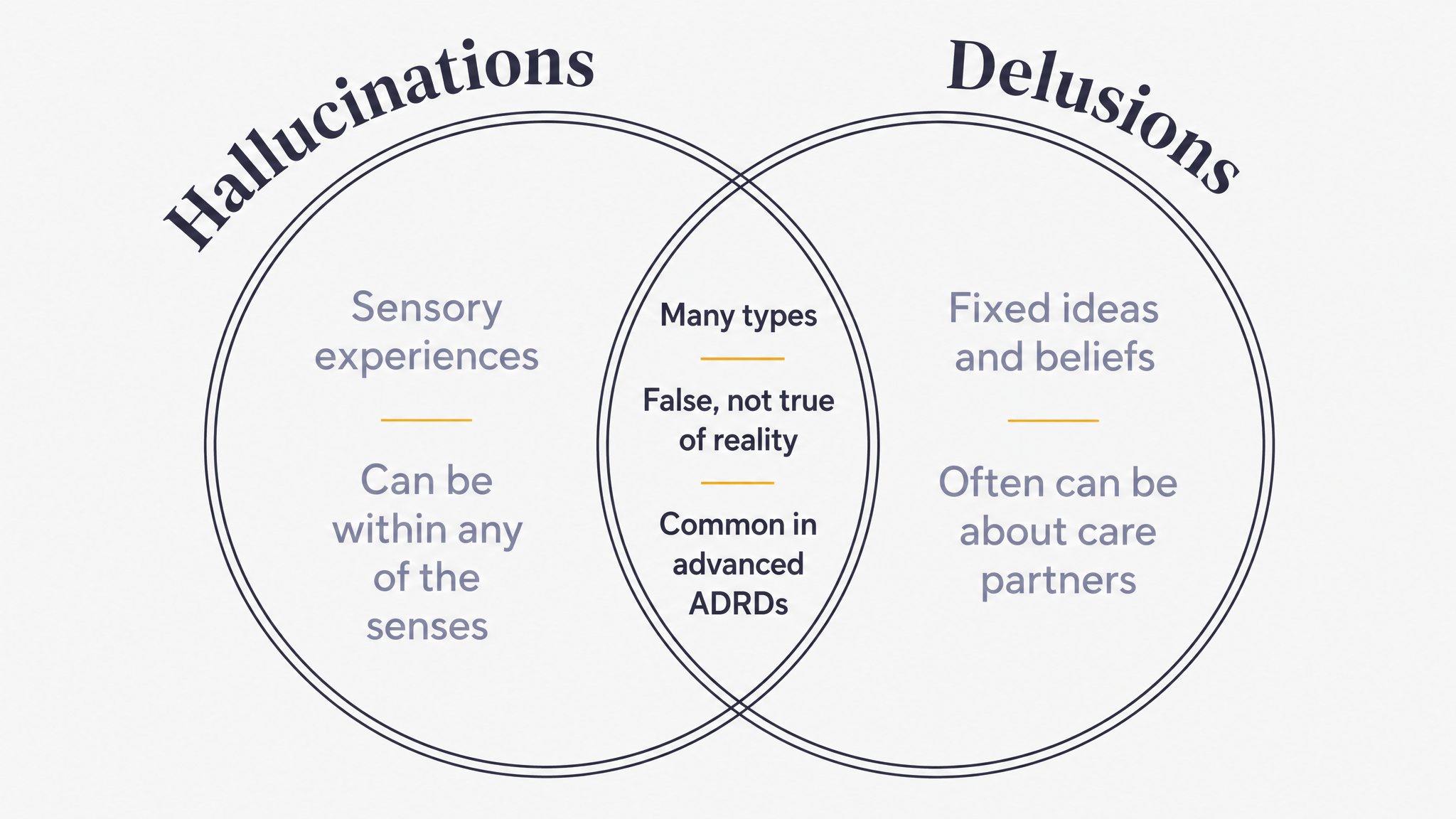
What's the Difference Between a Hallucination and a Delusion?

The two get lumped together, but they're not the same thing. 

Dementia Hallucination vs Delusion diagram

Source: Penn Memory Center


Both are common as dementia progresses. Penn Memory Center's research on dementia hallucinations found that up to half of people in the later stages of Alzheimer's disease and related dementias (ADRDs) experience hallucinations at some point. Delusions are common too, and the two sometimes show up together in the same person.


Why This Happens, and How It Looks Different by Type of Dementia

Dementia changes how the brain processes and interprets what the senses take in. That misfiring is what produces a hallucination or delusion. It’s neither a psychiatric break nor something your loved one can control or reason their way out of. 


Dementia hallucinations or delusions show up across dementia types, including vascular dementia, one of the most common causes of dementia after 65 and often overlapping with Alzheimer's.


The pattern shifts by type of dementia. 


With Lewy body dementia, visual hallucinations tend to show up early, sometimes before a diagnosis. When it happenes this early in the disease, the person may still sense on some level that what they're seeing isn't real. 


With vascular dementia, it's reversed. According to Alzheimer's Society's research on vascular dementia symptoms, delusions happen occasionally, most commonly a belief that someone has taken something from them, or that a loved one who has passed is still alive and due home. Hallucinations happen even less often and tend to appear later, often alongside other late-stage symptoms like agitation or apathy.


That distinction matters. If your loved one has vascular dementia and starts having vivid visual hallucinations early on, speak to their doctor as soon as you can.


What Usually Triggers a Dementia False Belief Episode

Hallucinations and delusions rarely come out of nowhere. A few common triggers show up again and again.


Knowing your loved one's specific triggers gives you something to work with instead of just reacting after the fact.


What Not to Do

The instinct to gently correct someone, "Dad, there's no one there," rarely helps and often makes things worse. Arguing about what's real doesn't change what your loved one is experiencing. It just adds confusion and distress. 


Don't dismiss what they've described, laugh it off, or leave them alone with it.


How to Respond in the Moment

It helps to have one simple sequence to fall back on in the moment. Dementia specialists at Penn Memory Center recommend a three-step approach.

  1. Understand. Ask about what they're experiencing without challenging it. A simple, curious question shows you're listening rather than dismissing. 
  2. Validate. Acknowledge how they're feeling, not whether the hallucination is real. Fear, confusion, or even delight are all worth naming out loud. 
  3. Reassure. Let them know they're safe, and that you're right there with them. 

None of this requires you to lie or pretend you see what they see. It just means meeting them where they are instead of pulling them into an argument they can't win and don't need to be having.


When to Call the Doctor

Most hallucinations and delusions in dementia don't require an emergency call, but a few signs mean it's time to loop in the doctor rather than wait it out.


Mention any illnesses or medications your loved one is currently taking when you call. The NIA’s  guidance on coping with hallucinations points out that sometimes an infection or a drug interaction is the real cause, and treating that clears up the hallucinations without anything else needing to change.


It's Okay If Dementia Confusion Scares You

Knowing you shouldn't argue is one thing. Staying calm while your father talks to someone who isn't there is another. That gap between what you know and what you feel in the moment is normal. It doesn't mean you're doing this wrong.


Watching someone you love respond to something that isn't there is disorienting, even when you expected it. 


Fear, sadness, a jolt of adrenaline, these are ordinary reactions, not signs of failure. Freezing for a second before knowing what to say isn't a mistake either. It takes practice, and you genuinely have no control over what's happening in your loved one's brain.


Right after an episode, once your loved one is calm and safe, give yourself a moment too. A few slow breaths, a text to someone who gets it. Skip the urge to replay what you did wrong. If dread starts building before every shift, that's worth mentioning to a doctor or counselor. 


Respite care for caregivers is imparavtive, especially when your loved one has a ADRD.


How a Supervised, Structured Day Supports Stability

We won't claim a structured day prevents hallucinations or delusions in people with dementia. But a predictable routine, good lighting, familiar faces, and fewer overstimulating surprises can ease some everyday triggers. 

Trained eyes matter too. Our nursing staff and social and therapeutic activities team notice behavior changes during the day and pass them along to families and physicians, often catching a pattern before it becomes a crisis at home.


Let Our Nursing Team Share the Weight

You shouldn't have to be the only person watching for these changes. At Caring Hands AMDC, our RNs and CNAs are trained to notice shifts in behavior, mood, and perception, and to loop in your loved one's doctor when something looks off. That's one less thing on your plate.


Talk to Our Nursing Team


Questions Caregivers Often Ask About Dementia Hallucinations and Delusions

Why Does My Loved One Think I'm Stealing From Them?

This is one of the most common delusions in dementia, and it's rarely about you specifically. It's usually memory loss. They misplaced something and can't recall doing it, accompanied by a general sense that something feels wrong. 


Try not to take it personally, even though that's genuinely hard. Redirecting gently, "let's look for it together," tends to land better than arguing.


Should I Go Along With It or Correct Them?

Neither, exactly. You don't need to pretend you see what they see, or correct them either. Acknowledge their feelings, then gently reassure them they're safe. That middle ground works better than either extreme.


Are Hallucinations More Common in Certain Types of Dementia, Like Lewy Body?

Yes. Hallucinations tend to appear earlier and more often with Lewy body dementia than with other types. With vascular dementia, delusions are more common than hallucinations, and both tend to show up later as the condition progresses.


Is It Normal to Feel Shaken Afterward, Even When I Know What to Do?

Completely normal. Knowing the right response and feeling calm in the moment are two different things, and most caregivers need practice before the second one catches up to the first.


I Froze and Didn't Say the Right Thing. Did I Make It Worse?

Almost certainly not. There's rarely one perfect line that changes everything. Staying present and keeping your voice steady matters far more than finding exact words. You'll get more comfortable with practice.


See What Steady, Watchful Care Looks Like

Families come to us after a hard stretch of managing these moments alone. What we offer is another set of trained eyes on your loved one every day, and a team that knows the difference between a passing episode and something worth calling the doctor about.


See Our Care in Action


Being there matters more than being right.


Disclaimer: At Caring Hands Adult Medical Daycare, we love sharing resources, tips, and more to help our community thrive. However, please keep in mind that the information on our blog is for educational and inspirational purposes only. While we are experts in care, the content here is not a substitute for professional medical advice, diagnosis, or treatment.

We always recommend speaking with your primary physician or a qualified healthcare provider regarding any specific medical concerns or changes to your loved one’s care plan.

What Is Adult Day Care? A Comprehensive Guide to Services and Benefits

You want your loved one to be safe, cared for, and surrounded by kindness, but you also need time to rest, work, or take care of yourself. 

Perhaps you’ve heard about adult day care, but aren’t sure what it offers. For many caregivers, it’s a lifeline, providing seniors with a place to connect, laugh, and stay active while families gain time and peace of mind. 

In this article, we’ll answer what adult day care is, explore the services it provides, and share how it can bring comfort, balance, and joy to both seniors and their families.

What Is Adult Day Care?

It’s a planned program of activities and health services provided in a safe, caring group setting during the day. 

Think of it as a community center, but with trained health staff and a focus on keeping older adults and people with disabilities engaged and well. 

It’s a wonderful alternative to nursing homes or assisted living for individuals who don't need 24-hour supervision but cannot safely stay home alone. 

It lets participants socialize, receive care, and enjoy activities before returning home, promoting dignity, connection, and independence.

Types of Adult Day Care Services

Not all centers are the same, but most fall into a few categories based on the services they offer. 

Here are the services you can typically expect:

The goal is to prevent loneliness and keep minds sharp and spirits bright.

This takes the pressure off you to worry about meal preparation during the day.

Benefits for Participants

Placing a loved one in a day care program isn’t about sending them away; it’s about giving them a better, fuller day. 

The benefits for the participant are profound:

Benefits for Caregivers

You are a hero, but even heroes need a break. Caring for a loved one is demanding, and burnout is a real concern. 

Adult day care gives you:

Compassionate Adult Day Care in Baltimore and Dundalk You Can Trust

At Caring Hands Adult Medical Daycare, we’re here to support both you and your loved one. 

From skilled nursing care and nutritious meals to engaging activities and a warm, welcoming environment, everything we offer is designed with comfort, dignity, and connection in mind.

If you’re seeking trusted adult day care in Baltimore or Dundalk, we’d love to help.

Contact us today to learn more.